How to be more articulate
How to be more articulate: why your thoughts come out tangled, the daily one-minute drill that fixes it, and a way to check how clear you sound today.
By Malav Shah, founder of Meenu · Updated
Short answer
To be more articulate, practise turning a thought into a short spoken answer every day. Decide your point before you start, say it in one sentence, back it with one reason and one example, then stop. Record a one-minute answer, listen for where you filled, rushed or wandered, and say it again. Being articulate is a habit of structure, not vocabulary.
Key takeaways
- Articulate speakers decide the point first. Most tangled answers start before the speaker knows where they are going.
- Um and uh are signals that you are still planning. Fewer of them comes from planning sooner, not from trying harder not to say them.
- One unseen question a day, answered in a minute and then repeated once, is enough to build the habit.
What does being articulate actually mean?
Being articulate means a listener can follow you the first time. It has little to do with long words. An articulate answer has four things:
- A point. You could say the whole answer in one sentence if you had to.
- An order. The listener can tell what is the claim, what is the reason and what is the example.
- Plain words. The simplest word that is accurate.
- Steady delivery. A pace people can keep up with, and pauses instead of filler. If you relied on Poised to catch filler on calls, it shut down in October 2026; these are the closest alternatives.
People who seem naturally articulate are usually doing one thing you cannot see: they know their last sentence before they say their first. It is what interviews and talks reward most.
Why do your thoughts come out tangled?
Speaking is planning and talking at the same time. When the planning falls behind, you hear it. There are three common causes.
- You start before you have a point. You begin with background and hope the point turns up. The listener waits with you.
- You fill the planning gaps with sound. Clark and Fox Tree, studying large collections of recorded speech, argue that speakers use uh and um to announce a delay: a short one for uh, a longer one for um, for example while they search for a word or decide what to say next.[1] A filler is not a bad habit on its own. It is evidence that the plan ran out.
- You go too fast for your own plan. VirtualSpeech puts a conversational pace at about 120 to 150 words a minute.[2] Much faster than that and you outrun your thinking, which produces more restarts and more filler.
None of these is about intelligence or vocabulary. All three are fixed by planning a little earlier.
What is a simple structure for any answer?
Use four moves, known as PREP: point, reason, example, point. It fits a meeting, an interview, a class and a dinner table.
| Move | What you say | In a 60-second answer |
|---|---|---|
| Point | “I think specialists have the edge early in a career.” | About 10 seconds |
| Reason | “People hire you for the one thing you are clearly good at.” | About 15 seconds |
| Example | “My first job came from one project on pricing, not from my general degree.” | About 25 seconds |
| Point | “So specialise first, and widen later.” | About 10 seconds |
The second “point” matters most. It tells the listener you have finished, and it stops you adding one more thing.
How do you practise being articulate every day?
Reading about speaking does not change how you speak. This drill takes about three minutes.
- Take a question you have not seen. You need to practise thinking and talking together, so a rehearsed topic does not count.
- Take 15 seconds to decide your point and your example. Nothing else.
- Answer out loud for 60 seconds and record it.
- Listen back once. Note where the point arrived, each filler, and any sentence you restarted.
- Answer the same question again. The second take is where the improvement happens.
Public speaking clubs have used the same idea for decades. In Toastmasters' Table Topics, members answer a surprise question for one to two minutes, to build the ability to organise their thoughts quickly.[3]
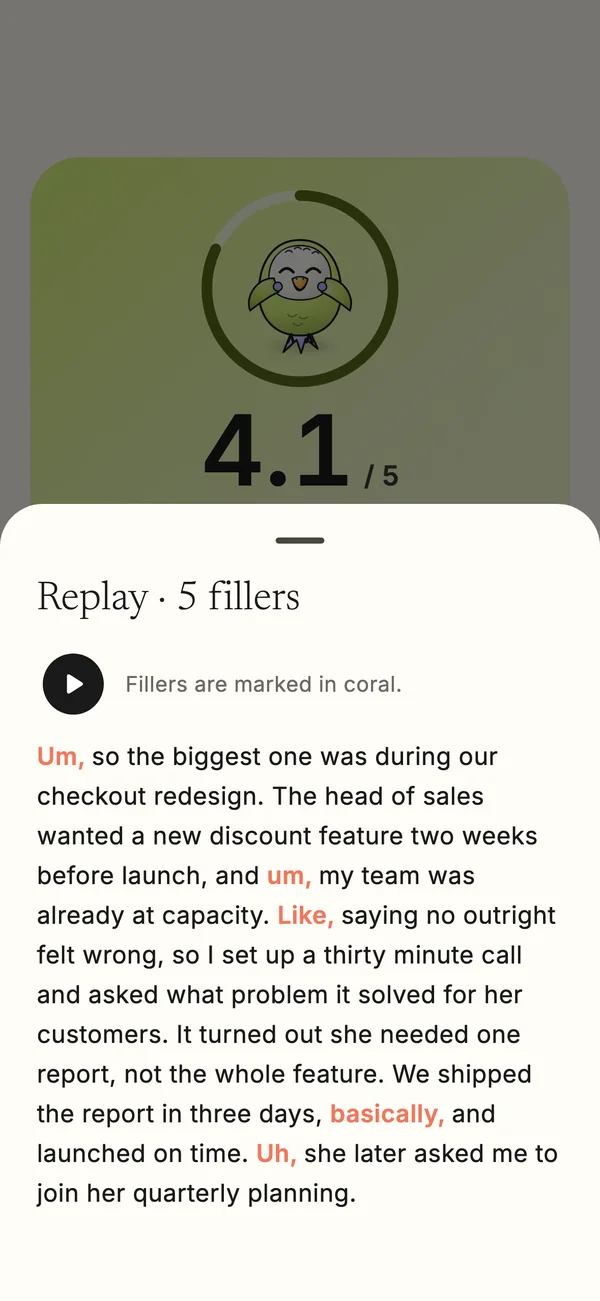
Meenu runs this drill for you: it gives you the question, times the fifteen and the sixty seconds, marks every filler in your transcript, checks your answer against a structure such as PREP, and shows a clearer version of what you said. You can find more questions in our impromptu speech topics.
What are the common problems, and how do you fix each one?
| What you notice | What is usually behind it | What to practise |
|---|---|---|
| You take a long time to get to the point | You start with background | Say the answer in your first sentence, every time |
| Lots of um and like | You are planning mid-sentence | Decide the point and the example before you start, and pause where the filler was |
| You restart sentences | You are speaking faster than you are thinking | Slow down for the first ten seconds |
| You trail off at the end | No last sentence decided | Repeat your point in new words, then stop |
| People ask “so what do you mean?” | A claim with no example | One concrete example in every answer |
What does a 7-day plan look like?
One unseen question a day, each with a different job. Do the five-step drill on each.
- Day 1, explain. “Explain how the internet works to a ten-year-old.”
- Day 2, give an opinion. “Is college worth the cost?”
- Day 3, tell a story. “Tell a story about a mistake that turned out well.”
- Day 4, give an update. “Share the results of last month's numbers with the team.”
- Day 5, persuade. “Pitch a new feature to your boss.”
- Day 6, introduce. “Introduce yourself at a networking event.”
- Day 7, repeat. Answer the Day 1 question again and compare the two recordings.
All seven are in Meenu's question bank, and there are 180 more in our 1-minute and impromptu topic lists.
How do you know you are getting more articulate?
We have no study to quote on how many days it takes, and we would be wary of anyone who gives you a number. Measure it yourself with three things you can count in a one-minute recording:
- Seconds to the point. How long before you said the sentence that answers the question?
- Fillers per minute. Count um, uh, like and you know.
- Restarts. Sentences you abandoned and began again.
Write the three numbers down once a week. If the first one is falling, the rest follow.
Frequently asked questions
Is being articulate about having a big vocabulary?
No. It is about order and clarity: a point, a reason, an example, and plain words. A large vocabulary used without structure sounds less clear, not more.
Why do I know what I want to say but can't say it?
Usually because you have the idea but not the sentence. Deciding your point in one sentence before you start talking closes most of that gap. If finding words has become suddenly or markedly harder, speak to a doctor.
How can I be more articulate at work?
Lead with the bottom line, then give the context. In meetings, write your one-sentence point before you speak. Practising one unseen question a day makes this automatic.
Is there an app to practise being articulate?
Meenu gives you one question a day and sixty seconds to answer it out loud, then shows your filler words, pace and structure with a clearer version of your answer. It costs $9.99 a month or $59.99 a year.
Sources
- Herbert H. Clark and Jean E. Fox Tree, “Using uh and um in spontaneous speaking (Cognition, vol. 84, 2002)”, checked 16 November 2026.
- VirtualSpeech, “Average Speaking Rate and Words per Minute”, checked 16 November 2026.
- Toastmasters International, “Table Topics Speaker”, checked 16 November 2026.