How to practise speaking a language alone
Seven ways to practise speaking a language alone, from talking to yourself to recording a daily answer, and how to find your mistakes without a tutor.
By Malav Shah, founder of Meenu · Updated
Short answer
You can practise speaking a language alone by producing full sentences out loud every day and then checking them. Describe your day, answer a question for one minute, record yourself and note what you could not say. Look those things up, then say the answer again. Speaking alone works when it has a prompt, a time limit and a way to find your mistakes.
Key takeaways
- Speaking is a separate skill from understanding. It improves only when you produce sentences yourself.
- The useful part of solo practice is noticing what you could not say, then fixing it and trying again.
- One minute a day with a question and a timer beats an hour once a week.
Can you learn to speak a language without a partner?
You can build most of the skill alone. Speaking means finding words and putting them in order fast enough to be understood, and you can practise that on your own every day.
Research on language learning supports the basic idea. A study in Studies in Second Language Acquisition found that producing the target language may, under certain circumstances, prompt learners to recognise some of their own linguistic problems.[1] In plain words: trying to say something shows you what you cannot yet say. Listening and reading do not do that.
What solo practice cannot give you is another person: listening at full speed, taking turns and being misunderstood. Add a partner or a tutor when you can. Until then, speaking alone is far better than not speaking.
What are the best ways to practise speaking alone?
Seven methods learners use, with what each one trains and what it leaves out.
| Method | What it trains | What it misses |
|---|---|---|
| Narrate what you are doing | Everyday vocabulary, speaking without translating | Nobody tells you when you are wrong |
| Describe your day each evening | Past tenses, linking sentences into a story | Easy to repeat the same safe phrases |
| Answer a question for one minute | Thinking and speaking at the same time, under a limit | Needs a supply of fresh questions |
| Shadow a recording (repeat just behind the speaker) | Rhythm, pronunciation, speed | You are copying sentences, not building your own |
| Record yourself and listen back | Hearing your own errors and hesitations | You only catch the mistakes you already know about |
| Read aloud | Pronunciation and confidence with the sounds | No sentence-building at all |
| Talk to an AI | Reacting to something unexpected | Many voice chats do not correct you unless you ask |
The strongest routine combines the third and fifth rows: a question you have not seen, a one-minute answer, and a recording you check afterwards.
How do you find your mistakes when nobody corrects you?
This is the hard part of practising alone, and the part that makes it work. Use a three-step loop.
- Catch the holes. While you speak, notice every moment you wanted a word or a form and did not have it. Do not stop. Say it another way and carry on.
- Fill them. Straight afterwards, write down the two or three things you could not say and look them up.
- Say it again. Answer the same question once more, using what you just looked up. This second attempt is where the new language sticks.
The holes are easy to find yourself. The errors you do not know you are making are not, which is where feedback helps.
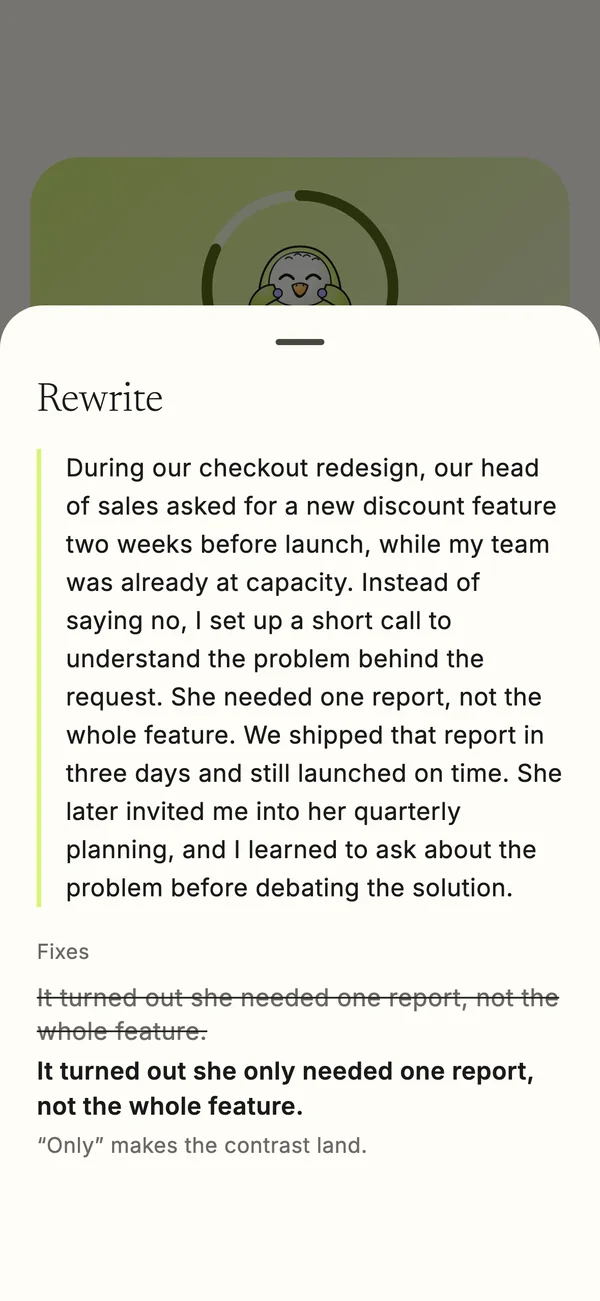
Meenu runs this loop in 24 languages: it gives you a question, times fifteen seconds to think and sixty to answer, then shows the grammar it fixed, the words that were hard to understand and a more natural version of what you said.
What should you talk about?
Anything you would say in your own language. Start concrete and move towards opinions.
- Describe: your home, your job, your route to work, what you ate yesterday.
- Explain: how to make a dish, how to get from the airport to your home.
- Tell: a story about a mistake, your first job, a journey that went wrong.
- Argue: whether remote work is better, whether everyone should learn a second language.
There are 180 more prompts in our 1-minute speech topics and impromptu speech topics; each works in any language. You need enough of the language to keep going for about a minute, so this suits learners who already understand a fair amount.
What does a daily routine look like?
Ten minutes or less. One spoken answer is the core; the rest supports it.
- Day 1. Describe your day in one minute. Write down three things you could not say.
- Day 2. Look those three up, then describe yesterday again.
- Day 3. Explain how to do something you know well.
- Day 4. Shadow two minutes of a podcast, then summarise it in your own words.
- Day 5. Tell a short story in the past tense.
- Day 6. Give an opinion and one reason for it.
- Day 7. Repeat the Day 1 task and compare the two recordings.
Does this work for any language?
Yes. The loop is the same whether you are learning English or Korean. In Duolingo's 2025 report, the most studied languages among its learners were English, Spanish, French, Japanese, German, Korean, Italian, Chinese, Portuguese and Hindi, in that order.[2] Meenu covers all ten, along with fourteen others such as Dutch, Arabic, Turkish and Indonesian.
Frequently asked questions
Is talking to yourself good for language learning?
Yes. It makes you produce sentences, which is the skill speaking depends on. It works best when you record it, note what you could not say, look those things up and try again.
How long should I practise speaking each day?
A one-minute answer plus a few minutes of checking and repeating is enough to make progress. Doing it every day matters more than doing it for long.
Can AI replace a conversation partner?
Partly. AI can give you questions and correct what you say at any hour. It does not replace real conversation, where you must listen at full speed and deal with being misunderstood. Use both if you can.
What level do I need to practise speaking alone?
You can narrate and read aloud from the start. Timed one-minute answers suit learners who already understand everyday speech but struggle to produce it.
Sources
- Izumi, Bigelow, Fujiwara and Fearnow, “Testing the Output Hypothesis (Studies in Second Language Acquisition, vol. 21, 1999)”, checked 16 November 2026.
- Duolingo, “2025 Duolingo Language Report”, checked 16 November 2026.