How to stop rambling with ADHD
Why ADHD makes you ramble, talk fast and interrupt, and a practical method: park side thoughts, decide your last line first, practise inside 60 seconds.
By Malav Shah, founder of Meenu · Updated
Short answer
With ADHD, rambling is rarely about not knowing what to say: the next idea arrives before the current one is finished. Decide your last sentence first, park side thoughts on paper instead of saying them, and practise answering inside a hard 60-second limit. Rehearsing out loud when nothing is at stake works better than trying harder in the moment.
Key takeaways
- Talking a lot, interrupting and speaking at the wrong moment are listed ADHD signs. They are not a character flaw, and they respond to practice.
- Park the tangent: write one word down and come back to the point.
- A 60-second limit is about 120 to 150 words, enough for one point and one example.
Why does ADHD make you ramble?
Not everyone with ADHD rambles, and plenty of people without it do. But the link is real. The CDC describes someone with the hyperactive-impulsive presentation as a person who “fidgets and talks a lot”, and notes that an impulsive person “may interrupt others a lot” or “speak at inappropriate times”.[1]
Adults report the same. In a 2025 survey of 179 multilingual adults, those with ADHD described more trouble regulating spoken conversation, in the form of “excessive talking, frequently interrupting others, and speaking without thinking first”.[2]
In practice it feels like this: you start answering, a better idea shows up halfway through the sentence, and you follow it. Then another. The listener hears three half-answers and no point. It costs most when the answer matters, in a job interview or a talk.
How do you stop going off on tangents?
You cannot stop the side thoughts from arriving. You can stop saying them out loud. The trick is to give each one somewhere else to go.
- Park it. Keep a pen or a notes app open in meetings and calls. When a tangent shows up, write one word that will bring it back, and finish your current sentence.
- Name the way back. If you are already on the tangent, say “Anyway, the point is…” and give the point. It sounds deliberate, not lost.
- Offer it, do not deliver it. “There is a related story, if you want it.” Most of the time nobody asks, and that is fine.
What structure works when your mind jumps around?
Keep it to three moves you can hold without effort: point, one example, point again. Then stop. A longer framework is one more thing for working memory to juggle while you speak.
The most useful habit is to decide your last sentence before you say your first. If you know where the answer ends, a detour has somewhere to return to. Write the three moves on a sticky note for calls if it helps. For work updates, the bottom-line-first version in how to stop rambling works the same way.
How do you slow down when you talk too fast?
Conversational speech runs at roughly 120 to 150 words a minute.[3] When excitement or nerves push you well above that, listeners stop keeping up, and you leave yourself no time to plan the next sentence.
- Shorter sentences. Each full stop is a free pause. Long chains of “and then” have none.
- Pause after the point. Two seconds of silence after your main sentence feels long to you and normal to everyone else.
- Measure it once. You cannot hear your own speed while talking. Record one minute, count the words, or use the free Speaking Score, which reports your pace and filler words.
Why practise out loud instead of just trying harder?
In a real conversation your attention is already full: listening, reading faces, waiting for your turn. That is the worst moment to learn a new habit. Practice moves the learning to a time when nothing is at stake.
- Take a question you have not seen.
- Give yourself 15 seconds to pick the point and the one example.
- Answer for 60 seconds and stop when the time ends.
- Listen back and find the sentence where you left the point.
- Answer again and stay on it.
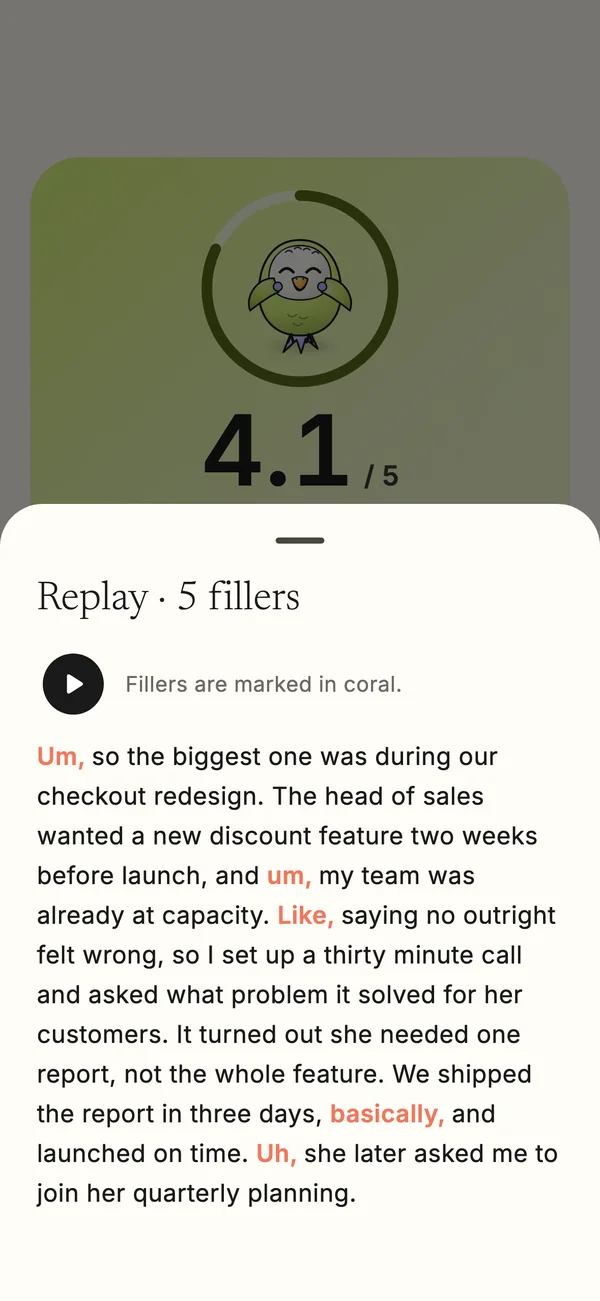
Meenu runs this drill for you: one question a day, a thinking timer, a 60-second answer, and a replay with every filler word marked. Short daily reps suit a brain that tires of long sessions. It is a practice tool, not an ADHD treatment.
How do you stop interrupting people?
Interrupting is usually fear of losing the thought. Remove the fear and most of the urge goes with it.
- Write the thought down. Once it is safe on paper, you can wait.
- When the other person stops, count two beats before you start.
- Start with a question about what they said, then add your point.
- If you do cut in, say “Sorry, go on” and mean it. People remember the repair more than the slip.
What does a week of practice look like?
One minute a day, one rule per day. Record every answer.
- Day 1. Answer any question. Count how many separate ideas you started.
- Day 2. Say your point in the first sentence.
- Day 3. Keep a pen in hand and park every side thought as one word.
- Day 4. One example only.
- Day 5. Shorter sentences: no “and then”.
- Day 6. End on your point and stay silent for two seconds.
- Day 7. Answer the Day 1 question again and compare the recordings.
Frequently asked questions
Is talking too fast a sign of ADHD?
Not on its own. Fast speech also comes from nerves, excitement or habit. Talking a lot and interrupting are among the signs the CDC lists for ADHD, but only a qualified clinician can diagnose it. If it worries you, talk to one.
Why do I ramble less in a second language?
A 2025 survey of multilingual adults found that excessive talking and interrupting were significantly reduced when people with ADHD spoke a second or third language. One likely reason is that a less fluent language makes you plan each sentence, which is the habit that stops rambling.
How do I stop losing my train of thought?
Decide your last sentence before you start, so there is always a point to return to. When you lose it, say "So the point is…" and give the sentence you planned. Writing one word for each side thought also keeps them from pulling you away.
Can an app help with ADHD rambling?
It can help you practise, not treat ADHD. Meenu gives you one question, a thinking timer and 60 seconds to answer, then replays your answer with filler words marked and shows your pace, so you can hear where you drifted.
Sources
- Centers for Disease Control and Prevention, “Symptoms of ADHD”, checked 20 November 2026.
- Franziska Köder, Cecilie Rummelhoff and Maria Garraffa, “Comparing pragmatic abilities across multiple languages in adults with ADHD (Clinical Linguistics and Phonetics, vol. 39, 2025)”, checked 20 November 2026.
- VirtualSpeech, “Average Speaking Rate and Words per Minute”, checked 16 November 2026.