How to stop rambling
How to stop rambling: why you circle before the point, a structure that fits 60 seconds, and a daily drill that shows where your answer wandered.
By Malav Shah, founder of Meenu · Updated
Short answer
To stop rambling, decide your last sentence before you say your first. Give the point, one reason and one example, then return to the point and stop talking. Rambling happens when you start speaking before you know where you are going. Practise with a 60-second limit: a hard stop teaches you to choose what to leave out.
Key takeaways
- Rambling is thinking out loud. The fix is fifteen seconds of thinking before you speak, not speaking faster.
- At work, give the bottom line first and the background second.
- A one-minute limit is about 120 to 150 words. Practising inside it trains you to cut.
Why do you ramble?
Rambling is not talking too much. It is talking before you have decided what you are saying. It usually comes from one of three places.
- You are finding the point as you go. The answer starts with background, takes a detour, and reaches the point last, if at all.
- Silence feels worse than filler. Researchers who studied recorded conversation argue that um and uh announce a delay while the speaker decides what to say next or holds their turn.[1] Ramblers keep talking for the same reason: to avoid a pause.
- You do not trust the short answer. So you add a second example, a caveat and a recap, and the listener loses the first thing you said.
It shows most when the answer matters: a job interview, a talk or an update in a meeting. If you have ADHD, this guide covers tangents and talking fast.
What structure stops rambling?
A structure is a decision about what comes last. Two are enough for most situations, and both are worth practising daily.
| Structure | Use it for | The moves |
|---|---|---|
| PREP | Opinions, explanations, answers to questions | Point, reason, example, point |
| BLUF | Updates, requests and decisions at work | Bottom line, context, recommendation, next step |
Both end by repeating or acting on the point. That last move is what tells you, and everyone else, that you are done.
How do you get to the point at work?
Say the bottom line first. Compare two versions of the same update.
Rambling: “So we started testing last week, and there were some issues with the payment flow, which we sort of expected, and then the vendor got back to us late, so anyway, we are probably looking at a delay.”
Bottom line first: “The launch moves from the 3rd to the 17th. Testing found a payment bug and the vendor's fix arrives Friday. I recommend we tell customers today. I will send the note by noon.”
The second version is shorter, and nobody has to ask “so what does that mean?”
How does a time limit help?
A limit forces a choice. At a conversational pace of roughly 120 to 150 words a minute, sixty seconds is about 120 to 150 words: room for one point, one reason and one example.[2] There is no room for the second example, so you learn to pick the better one.
Toastmasters clubs train this with Table Topics, where a member answers a surprise question for one to two minutes.[3] You can do the same alone:
- Take a question you have not seen.
- Give yourself 15 seconds to choose the point and the example.
- Answer for 60 seconds and stop when the time ends, mid-sentence if you must.
- Listen back and find the sentence where the answer should have ended.
- Answer again, and end there.
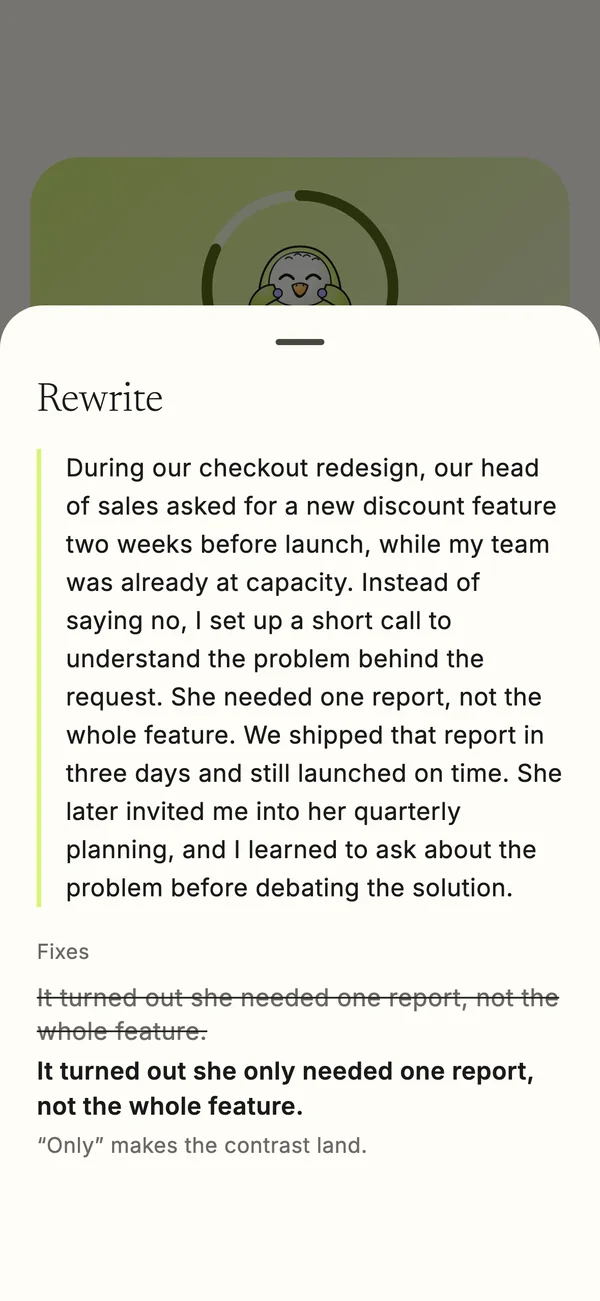
Meenu is built around this exact drill. It times the fifteen and the sixty seconds, checks whether your answer followed a structure, and names the part that was missing. Our list of 1-minute speech topics gives you questions to start with.
How do you stop rambling in meetings, interviews and conversations?
| Situation | What rambling sounds like | What to do instead |
|---|---|---|
| Giving an update | The history of the project, then the news | The news first, then one line of context and the next step |
| Answering an interview question | Your whole career before the example | One example, with the result said in the first two sentences |
| Being asked your opinion | “It depends” and both sides at length | Pick a side, give one reason, offer the caveat only if asked |
| Explaining something you know well | Every detail, in the order you learned it | The one thing they need, then “want more detail?” |
| Telling a story | A long set-up before anything happens | Start where something goes wrong, end on what changed |
What does a week of practice look like?
Seven days, one minute each, and one rule per day. Record every answer.
- Day 1. Answer any question, then find the sentence where it should have ended.
- Day 2. Say your point in the first sentence. Nothing before it.
- Day 3. One example only. If a second comes to mind, leave it out.
- Day 4. Give a work update in the order: bottom line, context, recommendation, next step.
- Day 5. Answer in 45 seconds instead of 60.
- Day 6. End by repeating your point, then say nothing for two full seconds.
- Day 7. Answer the Day 1 question again and compare the two recordings.
What should you do when you notice you are rambling?
Stop, and say one of these out loud. They work in meetings, interviews and conversations.
- “The short version is…” and then give the point.
- “Let me put that more simply.”
- “So, to answer your question: yes.”
Then stop talking. A pause after a clear sentence reads as confidence. It is also the moment the other person gets to respond.
Frequently asked questions
Is rambling a sign of nervousness?
Often. Nerves make silence feel longer than it is, so people fill it. But calm people ramble too when they start an answer without a point. Deciding the point first helps in both cases.
How do I stop over-explaining?
Give one reason and one example, then ask if the other person wants more detail. Over-explaining is usually an attempt to pre-empt questions. Let them ask.
How long should an answer be?
For most questions at work or in an interview, 30 to 90 seconds. If you need longer, say the point in the first 10 seconds so the rest has somewhere to hang.
Can an app help me stop rambling?
Yes, if it gives you a time limit and feedback on structure. Meenu gives you one question and 60 seconds, then shows whether your answer had a point, a reason and an example, and where the filler words were.
Sources
- Herbert H. Clark and Jean E. Fox Tree, “Using uh and um in spontaneous speaking (Cognition, vol. 84, 2002)”, checked 16 November 2026.
- VirtualSpeech, “Average Speaking Rate and Words per Minute”, checked 16 November 2026.
- Toastmasters International, “Table Topics Speaker”, checked 16 November 2026.