100 impromptu speech topics
100 impromptu speech topics from easy to hard, plus funny ones, with two example answers, three structures for any question and a way to practise.
By Malav Shah, founder of Meenu · Updated
Short answer
Impromptu speech topics are questions you answer with no preparation, usually for one to two minutes. The best ones can be answered from your own experience or argued either way. Below are 100 topics sorted by difficulty, from easy personal questions to abstract ones, plus funny topics, and three structures that work for any of them.
Key takeaways
- Start with personal questions; they need no knowledge, only an order.
- Pick a structure before you open your mouth: point, reason, example, point works for almost everything.
- Give yourself 15 seconds to think. That is enough to choose a point and an example.
What makes a good impromptu speech topic?
A good impromptu topic needs no research. Anyone in the room could answer it, and no two people would answer it the same way. It is narrow enough for a minute or two and open enough to take a side.
Toastmasters calls its version Table Topics: a member answers a surprise question for one to two minutes, to build the ability to organise their thoughts quickly.[1] The topic is only the excuse. The skill is the organising.
What are easy impromptu speech topics?
Personal questions. You already know the content, so all your attention can go on the order.
- What is the best meal you have ever eaten?
- Describe your perfect weekend.
- Who has taught you the most?
- What is your favourite place in your town?
- What would you do with an extra hour every day?
- Describe the last thing that made you laugh.
- What skill do you wish you had learned earlier?
- Tell us about a book or film you keep recommending.
- What is the best gift you have ever received?
- Describe your morning routine and one thing you would change.
- What was your first job, and what did it teach you?
- Which season do you like best, and why?
- Introduce yourself and your hometown to new friends.
- What is one small habit that improved your life?
- Describe a teacher you will never forget.
- What is your favourite way to spend a rainy day?
- Tell a story about a time you got completely lost.
- What would you cook for someone you wanted to impress?
- What is something you are proud of this year?
- Describe a tradition in your family.
- What is the best advice you have been given?
- What did you want to be when you were ten?
- Describe a place you want to visit and why.
- What is a small thing that makes your day better?
- Tell the story behind your name.
What are impromptu topics that ask for an opinion?
Take a side in your first sentence, give one reason and one example, and say the side again.
- Is remote work better than office work?
- Does social media do more harm than good?
- Should homework be banned?
- Is college worth the cost?
- Should AI be allowed to write school essays?
- Is it better to be a generalist or a specialist?
- Is short-form video ruining attention spans?
- Should cities ban cars from their centres?
- Is it better to rent or to own a home?
- Should everyone learn to code?
- Is a four-day work week realistic?
- Should voting be compulsory?
- Are exams a fair way to measure ability?
- Is it better to work for a big company or a small one?
- Should schools start later in the morning?
- Is talent more important than hard work?
- Should tipping be abolished?
- Do we rely too much on our phones?
- Is competition good for children?
- Should public transport be free?
- Is it better to save or to spend when you are young?
- Should meetings be banned one day a week?
- Are open-plan offices a mistake?
- Is travel the best form of education?
- If you were mayor for a day, what one law would you pass and why?
What are hard impromptu speech topics?
Abstract questions. The trick is to make them concrete at once: define the word, then tell one small story that shows it.
- What does success mean?
- Is honesty always the best policy?
- What is the difference between knowledge and wisdom?
- Can money buy happiness?
- What makes a good leader?
- Is change always progress?
- What do we owe to strangers?
- Is it better to be respected or liked?
- What is the purpose of education?
- Does technology bring people closer or push them apart?
- What is courage?
- Is failure necessary for success?
- What makes a place a home?
- Should we judge the past by today's standards?
- What is the most important invention in history?
- Is privacy still possible?
- What makes work meaningful?
- Are people more alike than different?
- What would you tell your younger self in one minute?
- Is it possible to be too kind?
- What will people a hundred years from now find strange about us?
- What is a risk worth taking?
- Does art need to be useful?
- When is it right to break a rule?
- What is one thing everyone should experience once?
What are funny impromptu speech topics?
Good for clubs, classes and warm-ups. Commit fully to the silly position; a serious structure makes it funnier.
- Does pineapple belong on pizza?
- Convince us that cats are better than dogs.
- Sell me this pen.
- Explain the internet to someone from the year 1800.
- Defend the worst film you have ever seen.
- Pitch a holiday on the Moon.
- Why should socks never be worn with sandals?
- Convince us to cancel Mondays.
- You have been made ruler of the world. What is your first decree?
- Explain why your favourite snack deserves an award.
- Pitch an app that would fix your morning routine.
- Argue that breakfast is the least important meal of the day.
- Convince your boss that naps should be compulsory.
- Describe your day as if you were a sports commentator.
- What would your pet say about you?
- Give a product review of the weather today.
- Argue that the stairs are better than the lift.
- Convince a vampire to try garlic bread.
- Explain a queue to an alien.
- Pitch a new national holiday.
- Which fictional character would make the best flatmate?
- Give a one-minute acceptance speech for an award you just invented.
- Argue that winter is better than summer, or the reverse.
- Persuade us that your least favourite vegetable is delicious.
- You meet your hero in a lift. Go.
How do you answer an impromptu topic well?
Choose one of three structures in your thinking time. Each gives you a first and a last sentence, which is most of the battle.
| Structure | Best for | The moves |
|---|---|---|
| PREP | Opinions and explanations | Point, reason, example, point |
| Past, present, future | Personal questions | How it was, how it is now, what comes next |
| Problem, solution, benefit | Pitches and proposals | What is wrong, what to do, what gets better |
When you run out of plan, pause. Researchers who studied recorded speech argue that um and uh are how speakers announce a delay while they decide what to say next.[2] A silent second does the same job and sounds calmer.
What are some impromptu speech examples?
Here are two answers, one to an abstract topic and one to an easy personal one. Both use point, reason, example, point.
“Is failure necessary for success?” (115 words)
“I think failure is necessary, because it is the only feedback you cannot argue with. When something works, you rarely find out why. When it fails, you have to. I learned that from my driving test. I failed the first time for not checking my mirrors, and I was furious, because I thought I was a good driver. For the next month I checked them so often that it became automatic. I passed the second time, and I still check them without thinking. If I had scraped through the first test, I would have kept the bad habit. So yes, failure is necessary, as long as you can say exactly what it was telling you.”
The topic is abstract, but the answer becomes concrete by the fourth sentence. That move, from a big word to one small story, is what makes hard topics manageable.
“Describe your perfect weekend.” (92 words)
“My perfect weekend has no plans on Saturday morning and one plan on Sunday. The empty morning matters because it is the only time in the week nobody needs anything from me. Last month I spent one reading on the balcony with a pot of tea, and I felt more rested by lunch than after a week off. Then on Sunday, one thing with people: a long lunch with friends, or a walk with my sister. So my perfect weekend is simple. One morning that is mine, and one afternoon that is shared.”
An easy topic still needs a point. “No plans, then one plan” gives the listener something to remember. If your mind goes blank before you find yours, see what to do when your mind goes blank.
How do you practise impromptu speaking alone?
- Pick a topic at random from the lists above. Do not choose a favourite.
- Take 15 seconds to choose a structure, a point and an example.
- Speak for 60 seconds and record it.
- Listen back for three things: when the point arrived, the filler words, and whether you ended on purpose.
- Answer the same topic once more, then move on.
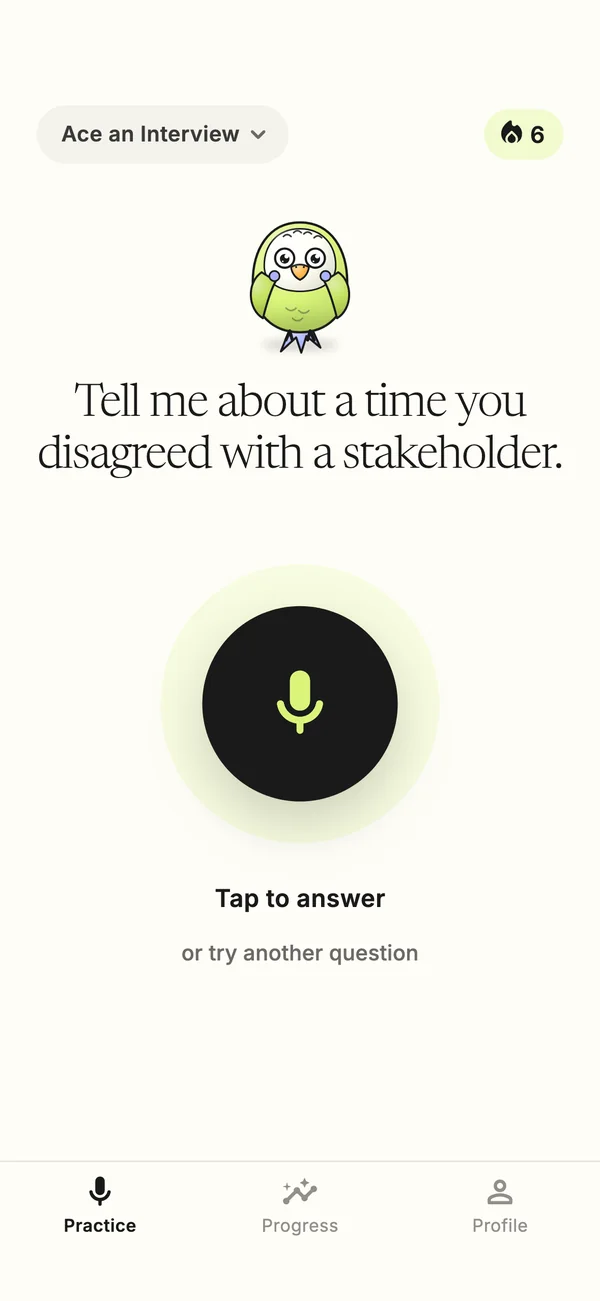
Meenu is this drill as an app. It gives you a question you have not seen, times the fifteen and the sixty seconds, marks every filler in your transcript, checks your structure and shows a clearer version of your answer. Shorter prompts are in our 1-minute speech topics, and the method is explained in how to be more articulate.
Frequently asked questions
How long should an impromptu speech be?
One to two minutes is standard in clubs and classes. For practice, sixty seconds is enough to make one point with a reason and an example.
How much time do you get to prepare?
Very little, often only a few seconds. Use it to pick a structure, one point and one example. Do not try to script sentences.
What if I know nothing about the topic?
Narrow it to something you do know. Say so in your first sentence ("I can only speak about this from my own experience") and then answer that smaller question well.
How do I get better at impromptu speaking?
Answer one unseen question a day, out loud, with a time limit, and listen back. Frequency matters more than length. Repeating the same question once is where most of the improvement comes from.
Sources
- Toastmasters International, “Table Topics Speaker”, checked 16 November 2026.
- Herbert H. Clark and Jean E. Fox Tree, “Using uh and um in spontaneous speaking (Cognition, vol. 84, 2002)”, checked 16 November 2026.