Why you understand a language but can't speak it
You understand the language but freeze when you speak. Why reading and listening do not turn into speech on their own, and a one-minute daily fix that does.
By Malav Shah, founder of Meenu · Updated
Short answer
You can understand a language but not speak it because listening and reading only ask you to recognise words, while speaking asks you to find and assemble them under time pressure. That is a separate skill, and it has to be practised directly. Speak in full sentences for a minute a day, notice what you could not say, look it up and say it again.
Key takeaways
- Understanding is recognition. Speaking is recall, at speed. One does not automatically become the other.
- The gap is normal, and it closes with output: saying things yourself, then fixing what went wrong.
- Give yourself thinking time at first. A question, fifteen seconds to plan and one minute to answer is enough.
Why can you understand a language but not speak it?
Because the two tasks ask different things of you.
| Understanding | Speaking | |
|---|---|---|
| What you do with a word | Recognise it when it arrives | Find it yourself, with nothing to prompt you |
| Grammar | Enough to get the meaning | Exact endings, order and tense, chosen by you |
| Time | The speaker sets the pace | Someone is waiting for you |
| Missing a word | You guess from context | The sentence stops |
Years of films, lessons and apps train the left-hand column. Very little trains the right. Research on language learning describes the same thing from the other side: producing the language may, under certain circumstances, prompt learners to recognise some of their own linguistic problems.[1] You find out what you cannot say only by trying to say it.
Is it normal to understand more than you can say?
Yes. It is true of your first language too: you understand many words you never use. In a second language the difference is simply wider, and it widens further the more you listen without speaking.
It is not a sign that you are bad at languages, or that you need more vocabulary. People in this position often keep studying, when what they are short of is practice at producing what they already know.
Why do you freeze in real conversations?
A real conversation stacks three difficulties on top of each other.
- No thinking time. You have to understand, decide what you think and build a sentence in a second or two.
- A listener. Someone is watching you search for a word, which makes the search slower.
- No second attempt. If the sentence comes out wrong, the conversation has already moved on.
Practise with those removed, then put them back one at a time. Start alone, with time to think and the chance to repeat. Then shorten the thinking time. Then add a person.
What actually closes the gap?
Output, in a loop. Each round takes about three minutes.
- Take a question you could answer easily in your own language.
- Plan for 15 seconds. Decide what you want to say, not how.
- Speak for 60 seconds in full sentences. When a word is missing, go round it and keep talking.
- Note two or three things you could not say, and look them up.
- Answer again. The second attempt, with the gaps filled, is the one that changes how you speak.
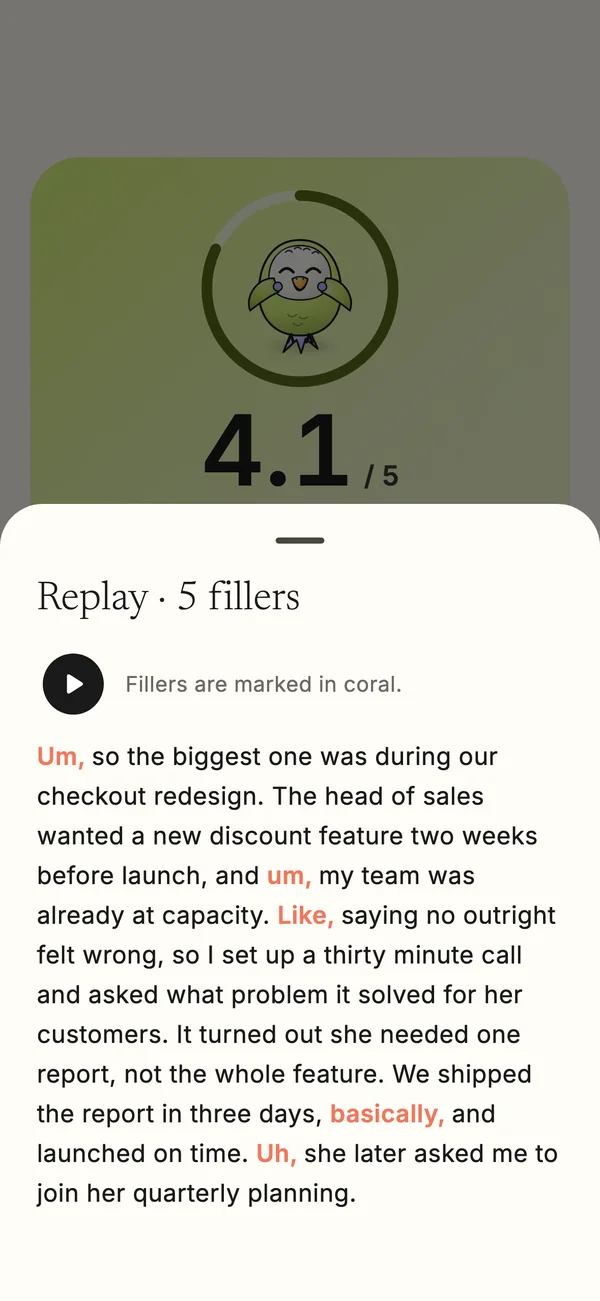
Meenu is built for this loop. It asks one question a day in the language you are learning, gives you the fifteen and the sixty seconds, then corrects the grammar in the sentences you actually said and shows a more natural version. More methods are in our guide to practising a language alone.
What does the first week look like?
- Day 1. Introduce yourself for one minute. Note what you could not say.
- Day 2. Introduce yourself again, with yesterday's gaps filled.
- Day 3. Describe what you did yesterday.
- Day 4. Explain how to do something you know well.
- Day 5. Tell a short story about something that went wrong.
- Day 6. Give an opinion and a reason, with only five seconds to plan.
- Day 7. Repeat Day 3 and compare the two recordings.
By Day 7 you will not be fluent. You should be starting sentences sooner and stopping less often, which is the first sign the gap is closing.
Is this only a problem for English learners?
No. It is the same for anyone who has learned mostly by reading, listening or tapping through an app. English is the most studied language among Duolingo's learners, followed by Spanish, French, Japanese, German and Korean.[2] The gap between understanding and speaking works the same way in each, and so does the fix. If English is the one you are working on, see English speaking practice.
Frequently asked questions
Why can I read a language but not speak it?
Reading lets you recognise words at your own pace. Speaking makes you recall them and build sentences in real time. You need to practise producing sentences out loud; more reading will not do it.
How long does it take to start speaking?
There is no honest fixed number. Watch for two signs instead: you start sentences sooner, and you stop less often in the middle. Fluency takes much longer and depends on how much you speak.
Do I need a tutor to get past this?
A tutor helps, especially with listening and real conversation. But the core skill, producing sentences, can be practised alone every day, and the two work well together.
Does speaking to AI help?
It can, if it makes you produce full sentences and corrects them. A tool that only chats without correcting gives you practice but leaves the same errors in place.
Sources
- Izumi, Bigelow, Fujiwara and Fearnow, “Testing the Output Hypothesis (Studies in Second Language Acquisition, vol. 21, 1999)”, checked 16 November 2026.
- Duolingo, “2025 Duolingo Language Report”, checked 16 November 2026.