80 1-minute speech topics
1-minute speech topics for class, clubs and JAM rounds: 80 ideas grouped by type, how many words fit in a minute, and a simple structure for each.
By Malav Shah, founder of Meenu · Updated
Short answer
A one-minute speech is about 120 to 150 words at a conversational pace: enough for one point, one reason and one example. Good one-minute topics are narrow. Explain one thing, argue one side or tell one short story. Below are 80 topics grouped by type, with a structure that fits sixty seconds and a way to practise them out loud.
Key takeaways
- Plan on 120 to 150 words. Fewer if you want room to pause.
- Use four moves: point, reason, example, point.
- Pick a topic you have not prepared, think for 15 seconds, then speak. That is the skill a one-minute speech tests.
How many words is a 1-minute speech?
It depends on your pace. VirtualSpeech puts conversational speech at about 120 to 150 words a minute and a comfortable presentation pace at 100 to 150.[1]
| Pace | Words in 1 minute | When it suits |
|---|---|---|
| Slow | About 100 | Formal talks, a large room, a second language |
| Average | About 130 | Class presentations, meetings, most practice |
| Fast | About 150 | Conversation, stories, anything you know well |
If you are writing a speech out first, aim for 120 words. That leaves room to pause and to breathe.
How do you structure a 1-minute speech?
One minute holds one idea. Use four moves and give each a share of the time.
- Point (about 10 seconds). Say your answer or your claim in one sentence.
- Reason (about 15 seconds). Why it is true or why it matters.
- Example (about 25 seconds). One story, number or picture. This is the part people remember.
- Point again (about 10 seconds). Repeat the claim in fresh words, and stop.
For a story, swap the middle for what happened and what changed. For a pitch, swap it for the problem and the proof. Our guide to getting to the point has worked examples.
What does a good 1-minute speech sound like?
Two sample answers, each built on the four moves above. Read one aloud with a timer to feel the length.
“Should homework be banned?” (119 words)
“Homework should not be banned, but it should be shorter. The point of homework is practice, and practice works in small doses. When I was fourteen, my maths teacher set five problems a night instead of thirty. We all did them, because five felt possible, and she could see the next morning exactly who was stuck. In the class next door, thirty problems meant half the students copied the answers on the bus. Same subject, same school, very different result. So the question is not homework or no homework. It is whether the work is small enough that students actually do it and teachers actually read it. Keep homework, cap it at twenty minutes, and it does its job.”
“Tell the story behind your first job.” (118 words)
“My first job taught me to ask questions early. I was sixteen, working weekends in a bakery, and on my second day the owner told me to prepare the dough for the morning. I had no idea how much, and I was too embarrassed to ask. So I guessed, and I made four times what we needed. We spent Sunday giving bread away to everyone on the street. The owner laughed, but she also said something I still use: a question costs ten seconds, a guess can cost a day. Since then, in every job, I ask the obvious question in the first minute. It has never once made me look as silly as that mountain of dough.”
Both open with the point, spend most of their time on one example, and end by returning to the point.
What are good 1-minute topics that explain something?
These test whether you can make something simple. Pick the one you know least well; it is better practice.
- Explain how the internet works to a ten-year-old.
- Explain why the sky is blue.
- Explain inflation in simple words.
- Explain how to make your favourite dish.
- Explain what you do at work to your grandmother.
- Explain a concept from your favourite subject.
- Explain how a vaccine works.
- Explain the rules of your favourite sport.
- Explain how to get from the airport to your home.
- Explain what AI is to someone who has never used a phone.
- Explain how a bill becomes a law where you live.
- Explain why we have time zones.
- Explain how to save money on a small income.
- Explain how a search engine decides what to show.
- Explain why sleep matters.
- Explain a hobby of yours to a complete beginner.
What are good 1-minute topics for arguing a side?
Choose a side in the first sentence. A minute is too short to sit on the fence.
- Remote work is better than office work.
- Social media does more harm than good.
- Should homework be banned?
- Is college worth the cost?
- Should AI be allowed to write school essays?
- Is it better to be a generalist or a specialist?
- Short-form video is ruining attention spans. Agree or disagree?
- Should voting be compulsory?
- Cities should ban cars from their centres.
- Everyone should learn a second language.
- A four-day work week should be the norm.
- Should schools teach personal finance?
- Books are better than films.
- Is failure a better teacher than success?
- Should phones be banned in classrooms?
- If you were mayor for a day, what one law would you pass and why?
What are good 1-minute topics for telling a story?
Start in the middle of the action and end on what changed.
- Tell the story of the best day of your life.
- Tell a story about a time you got completely lost.
- Describe a moment that changed how you see the world.
- Tell the story behind your first job.
- Tell a story about a mistake that turned out well.
- Tell a story about your favourite teacher.
- Tell a funny story about learning a language.
- Describe the best meal you have ever eaten.
- Tell the story of how you met your closest friend.
- Describe a time you changed your mind.
- Tell a story about a journey that went wrong.
- Describe the proudest moment of your life so far.
- Tell the story of something you built or made.
- Describe a time you were brave.
- Tell a story about a piece of advice you ignored.
- Describe a place that feels like home.
What are good 1-minute topics for pitching and persuading?
Open with why the listener should care, and finish with what you want them to do.
- Pitch an app that would fix your morning routine.
- Sell me this pen.
- Pitch a new feature to your boss.
- Convince your class to join your club.
- Pitch yourself for a promotion.
- Pitch a four-day work week to your CEO.
- Convince a city to build more bike lanes.
- Pitch your startup to an investor in 60 seconds.
- Convince a friend to read your favourite book.
- Pitch your town to a tourist.
- Convince your family to adopt a pet.
- Pitch a film you would love to see made.
- Convince a stranger to try your favourite food.
- Pitch a change that would improve your school or workplace.
- Convince someone to take up your favourite sport.
- Pitch a holiday destination to a friend with a small budget.
What are good 1-minute topics for work and introductions?
The one-minute speeches people give most often are not speeches at all: an introduction, an update, a thank-you.
- Introduce yourself at a networking event.
- Introduce yourself on the first day of a new job.
- Introduce yourself to a new class.
- Introduce yourself and your hometown to new friends.
- Give a status update on a project that is behind schedule.
- Announce a change in plans to your team.
- Kick off a project meeting and set the goal.
- Ask your team for help on a blocker.
- Recommend one of two options and explain why.
- Share last month's results with your team.
- Thank a colleague in front of the team.
- Welcome a new member to your group.
- Introduce a guest speaker.
- Give a toast to a friend in one minute.
- Tell me about yourself.
- Describe a project you are proud of.
What are good Just a Minute (JAM) topics?
JAM, short for Just a Minute, is a one-minute speaking round used in colleges, clubs and placement interviews. It borrows its rules from the BBC Radio 4 panel game, where players talk on a subject “for just a minute, without repetition, hesitation or deviation”.[3] So the best JAM topics are ones you can keep talking about without circling back.
- A rainy day
- My favourite app
- Traffic
- The last film I watched
- Mornings
- Online shopping
- My hometown
- Street food
- Exams
- A habit I want to break
- Social media
- My first phone
The three faults are the ones a timer exposes. Hesitation is a pause where your mind went blank; repetition and deviation are what rambling sounds like. Choose your point in the first five seconds and one example to carry you to the end. For the moment you freeze, see how to think on your feet.
How do you practise a 1-minute speech?
- Pick a topic at random, so you cannot prepare it.
- Take 15 seconds to choose your point and your example.
- Set a timer for 60 seconds, speak, and record yourself.
- Listen once: where did the point arrive, how many filler words, did you finish in time?
- Do the same topic again.
This is how Toastmasters clubs practise too. In Table Topics, a member answers a surprise question for one to two minutes to learn to organise their thoughts quickly.[2]
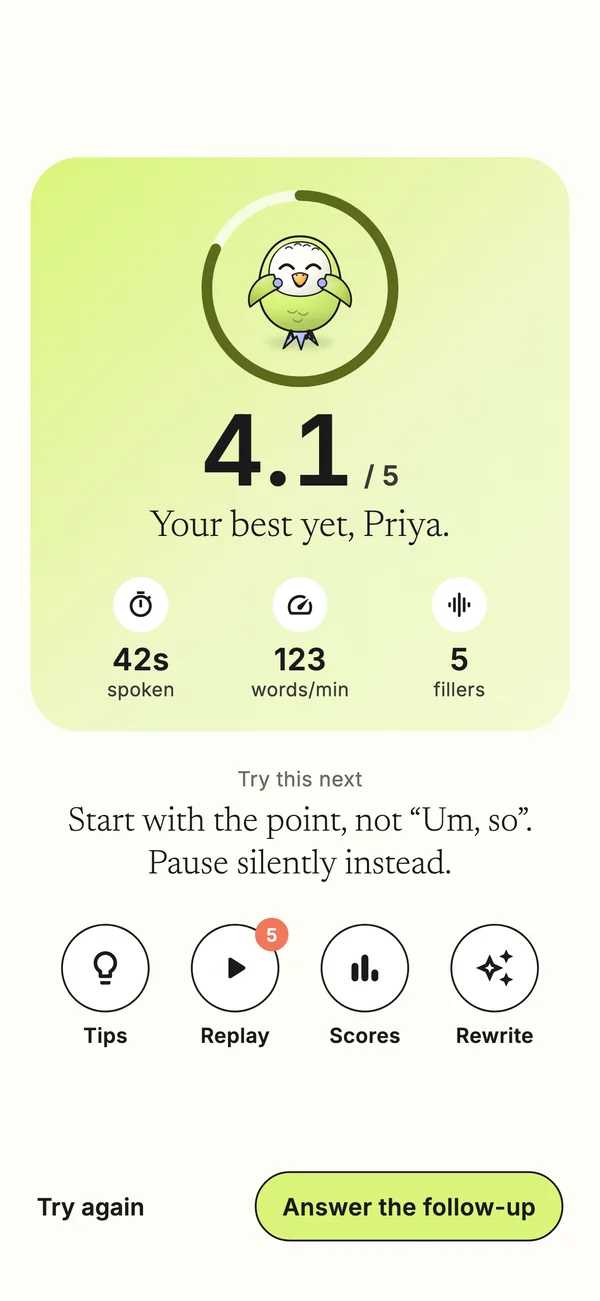
Meenu does the timing and the listening for you. Many of the topics above come from its question bank. It gives you one a day, times the fifteen and the sixty seconds, and shows your pace, your filler words and a clearer version of your answer. For harder prompts, see our impromptu speech topics.
Frequently asked questions
How long is a 1-minute speech in words?
About 120 to 150 words at a conversational pace, or closer to 100 if you speak slowly or want room for pauses.
Can you say something useful in one minute?
Yes, if you say one thing. A point, a reason and an example fit comfortably in sixty seconds. Most one-minute speeches fail by trying to cover three ideas.
What is a good 1-minute speech topic for students?
Something you can explain or argue from your own experience: should homework be banned, explain a concept from your favourite subject, or tell a story about your favourite teacher.
What is a JAM session?
JAM stands for Just a Minute. Each speaker gets a topic and talks for one minute without hesitating, repeating themselves or going off topic. Colleges and some employers use it to see how you think and speak under a little pressure.
How do I stop running over time?
Write or plan for 120 words, not 150, and decide your last sentence before you begin. Practise with a timer and stop when it ends, even mid-sentence.
Sources
- VirtualSpeech, “Average Speaking Rate and Words per Minute”, checked 16 November 2026.
- Toastmasters International, “Table Topics Speaker”, checked 16 November 2026.
- British Comedy Guide, “About Just A Minute”, checked 21 November 2026.